

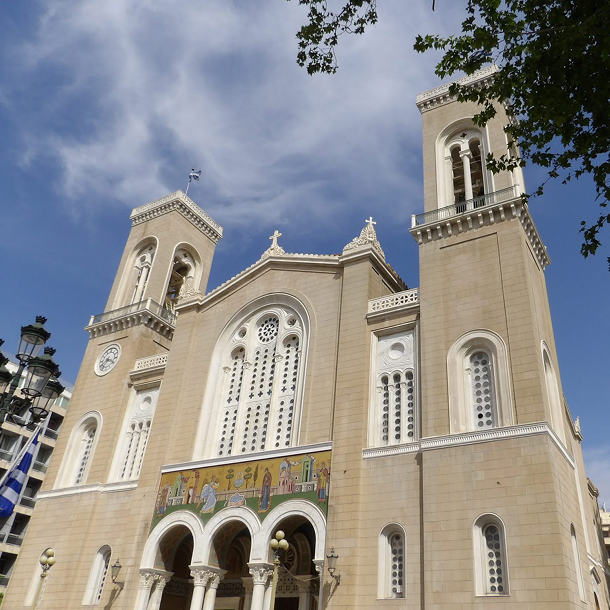
The Metropolitan Cathedrial of Athens
The church is located in Metropoleos Square, 350 metres to the West of Syntagma Square, and is dedicated to the Annunciation of the Mother of God.
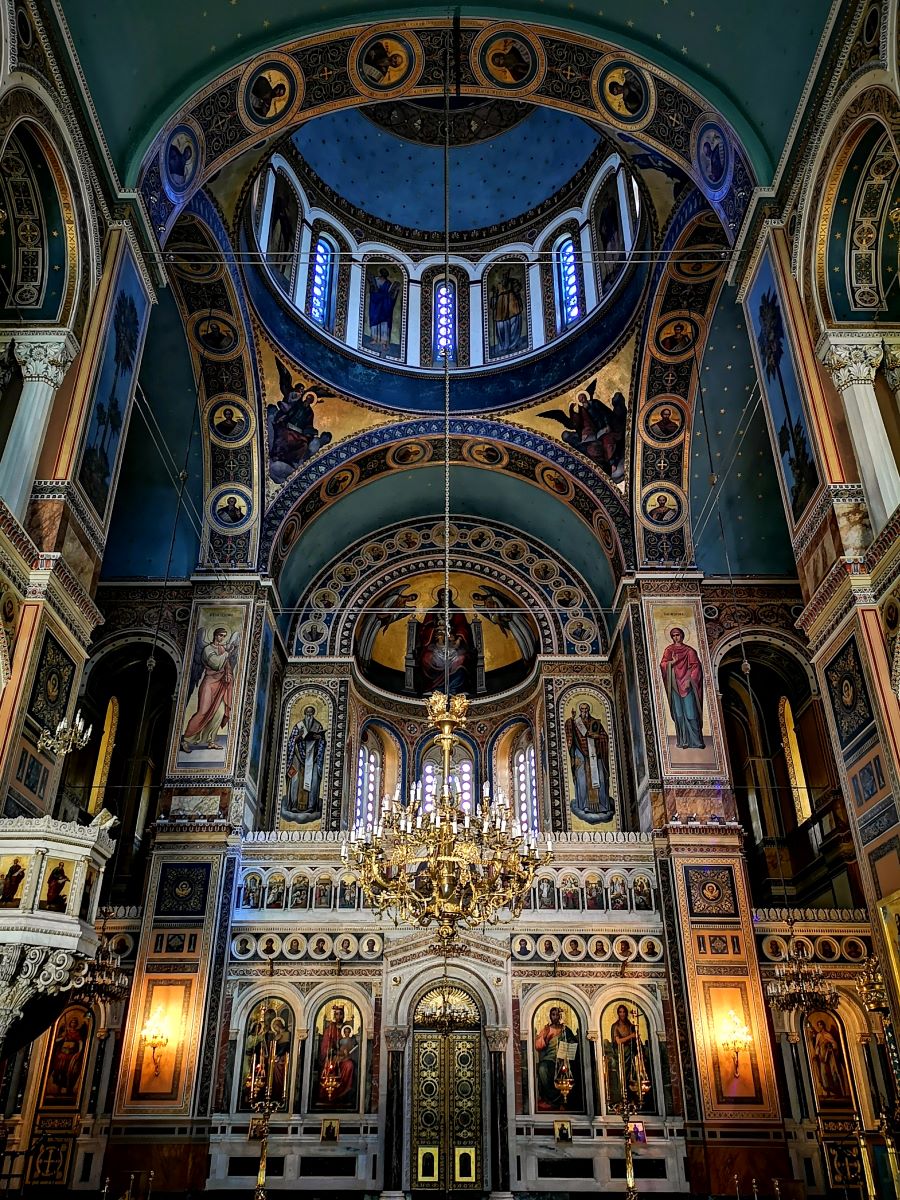
On the exterior it bears features of different styles and has a dome, while in the interior it constitutes a three-aisled basilica. In terms of its history let it me noted that, originally, pursuant to a decree issued on April 3/15, 1838, it was stipulated that a Church of the Saviour should be constructed in the square called Otto’s Square at the time (today Omonoia Square) “as a national monument indeed, expressing the gratitude of the Nation to the Most High” for its liberation from the Turkish yoke. However, because of the inability of the Public Fund to cover the expenditure required, and of the meagre revenue collected following a fundraiser, by virtue of a new decree of April 15 / May 7, 1842, it was decided that the church would be constructed not in Otto’s Square but on a plot of land at 24, Panepistimiou Street, where today the Catholic Cathedral Basilica of Saint Dionysius the Areopagite is located, according to plans elaborated by Theophil Hansen and providing for the construction of a church with elements of Gothic, Romanesque and Renaissance architectural style. Nonetheless, that decision too was changed and by means of a decree dated November 20 / December 2, 1842, today’s location was finally chosen. Once the buildings or ruins of buildings (churches etc.) existing there had been demolished, on December 25, 1862, its foundation took place, with the works having been completed in 1858 following interruptions which intervened for financial reasons. In 1853 the architect Demetrios Zezos radically revised Hansen’s plans and designed a church in “a Greek Byzantine style” (from Hansen’s plans only the propylon remains). In 1855, because of the death of Zezos, Panayiotis Kalkos and François Boulanger took up the supervision of the project successively, and gave the building the form it has to this day. In 1859 Spyridon Ghiallinas painted the icons of the iconostasis and designed its frescoes, which were executed by the Bavarian Alexander Maximilian Seitz (1862), while the painted decoration was the work of Constantinos Phanellis, and the sculpted architectural elements, the column capitals and (later on) the larnax of Saint Gregory V were due to Gheorghios Phytalis.
The entire expenditure amounted to 800,000 drachmas, half of which came from the sale of church lands, another 80,000 from the Municipality of Athens, 10,000 from Gheorghios Sinas, 86,000 from his son Simon SInas, and the remaining amount from the faithful. The inauguration was held on May 21, 1862, by Mishael Apostolides, Metropolitan of Athens, and Synodic Bishops. Unfortunately, because of the nature of the subsoil and the earthquakes which happened both in the end of the 19th century, and in 1981 and again in 1999, the church suffered significant damage, which was successfully addressed, and, following its full restoration, it now receives its hundreds of pilgrims every day in splendour. This magnificent church is connected with all the core historical events of the Greek nation, and it is in it that the solemn ceremonies are performed, as it also constitutes the official see of each Archbishop of Athens.
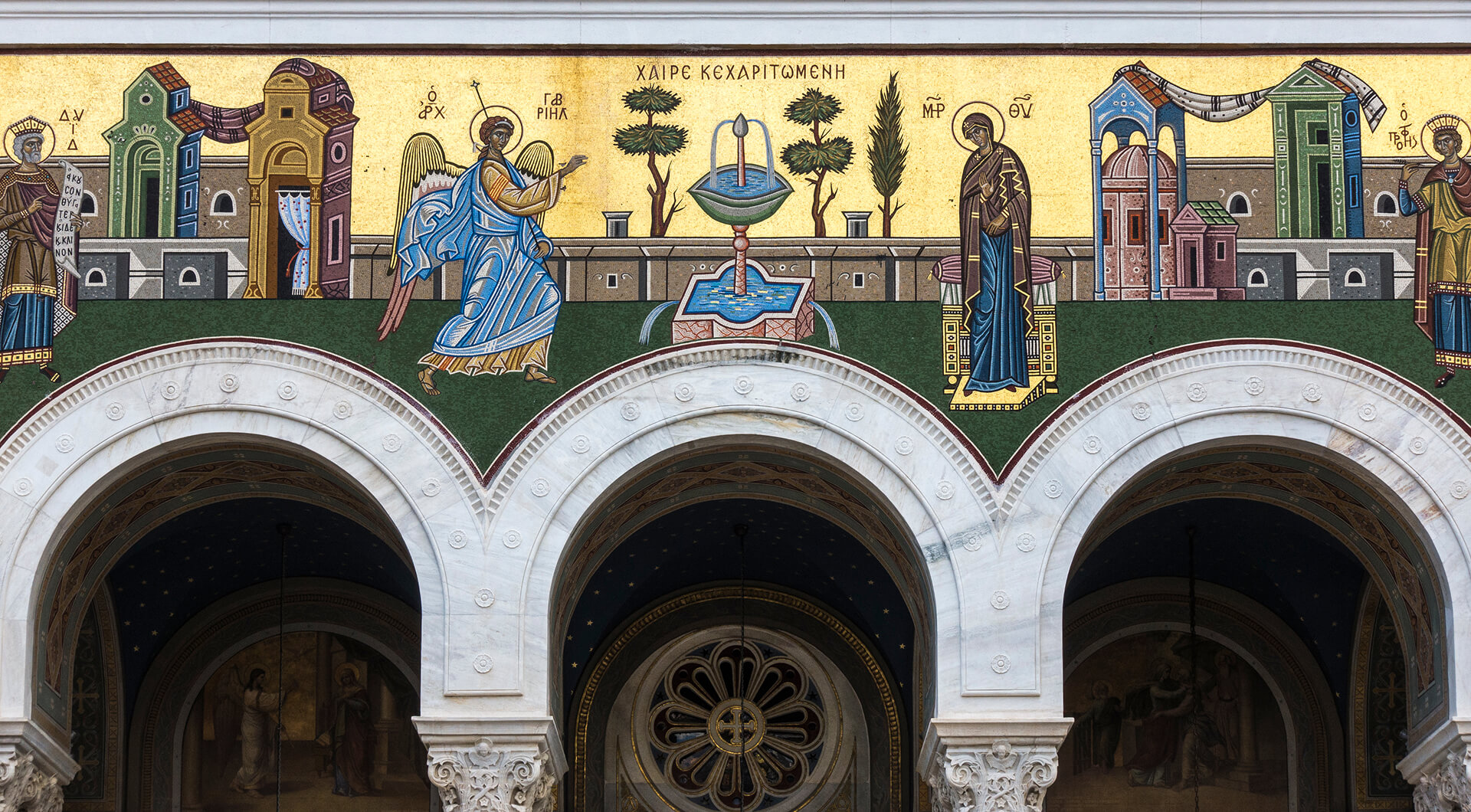
The Entrance of the Church
The entrances to the church truly adorn it. The western entrance is accentuated by an arcade which is supported by two twin marble columns and respective twin pilasters. The column heads are of a form similar to that of the columns of the interior and are most rich in decoration. The arcade is of a tripartite arrangement with a narrow band above and a wider one below. The latter bears anthemia in relief placed at regular intervals. Above the arcade there is a large mosaic depiction of the Annunciation of the Mother of God, a work by Elli Voila (an important mosaic artist and painter, 1908-1989).
The icon of Jesus Christ
Inside a sculpted shrine, a work by the sculptor Stratis Philippotis (1996) the icon of Jesus Christ is placed. It was dedicated to the church as a token of thanks given by the city of Athens to Christ for its liberation from its Occupation by the Germans (1944). The donation was made by the “All-Holy Virgin Mary the Liberatress” Panhellenic Association of the Orthodox during the chairmanship of the icon painter Antonios Stanitsas in 1962, who also created the icon.
The All-Holy Virgin Mary the Liberatress
Inside another shrine also sculpted in marble, also a work by the sculptor Stratis Philippotis (1996), the icon of the All-Holy Virgin Mary the Liberatress has been placed, donated by the Stanitsas brothers, Antonios and Leonidas, in 1948, and is dedicated to the memory of their mother and to the prosperity of the nation, its armed forces and “unredeemed” Greeks.
Reliquary of Saint Philothei
In the heirloom vault of the Cathedral of Athens heirlooms and utensils of inestimable historical value and great artistry are kept. However, in the main church the holy relics of two martyrs of Orthodoxy are also treasured, i.e. those of Saint Philothei and Patriarch Gregory V of Constantinople. Saint Philothei, who was a descendant of the wealthy family of the Benizelos’s and the Palaiologos’s, was martyred by the Turks in 1589, because of her social work, which was revolutionary by the standards of her time. Her old, austere reliquary was in the Metropolitan Church already from the first years of its operation and was recently replaced by a silver gold-plated shrine with semi-precious stones in the northern central part of the church. Indeed, when some years ago (2006) the wooden shrine was opened so that the relics be placed inside the new one, it was surprisingly discovered that apart from the holy relics there were also an icon of the 16th century, two wood-carved crosses —one of which probably was the Saint’s own cross as Abbess (Hegumeni in Greek)— as well as a box, inside which, following her passing, when she exuded myrrh, the latter was collected and kept inside it. All this is there inside the shrine.
Reliquary of Saint Gregory V
To the southern and central part of the church there is a shrine sculpted in marble, a work by the great sculptor Gheorghios Phytalis, in which the whole-body holy relic of Saint Gregory V, National Martyr and Patriarch of Constantinople, is enshrined. The Holy National Martyr Gregory V was hanged by the Ottomans on April 10, 1821, on the front gate of the Patriarchate of Constantinople, in response to the uprising of the Nation, and his body was thrown into the Bosphorus. It was recovered from the sea by the Greek captain Nikolaos Sklavos and transported to Odessa of Russia, where it was buried at the Greek church of the Holy Trinity. His relic was kept in Odessa until 1871, when, on the occasion of the 50th Anniversary of the Greek Revolution, it was translated with honours and enshrined in the Cathedral during Metropolitan Theophilos’ time.
All-Holy Mother of God Myrtidiotisssa (“of the Myrtle Tree”)
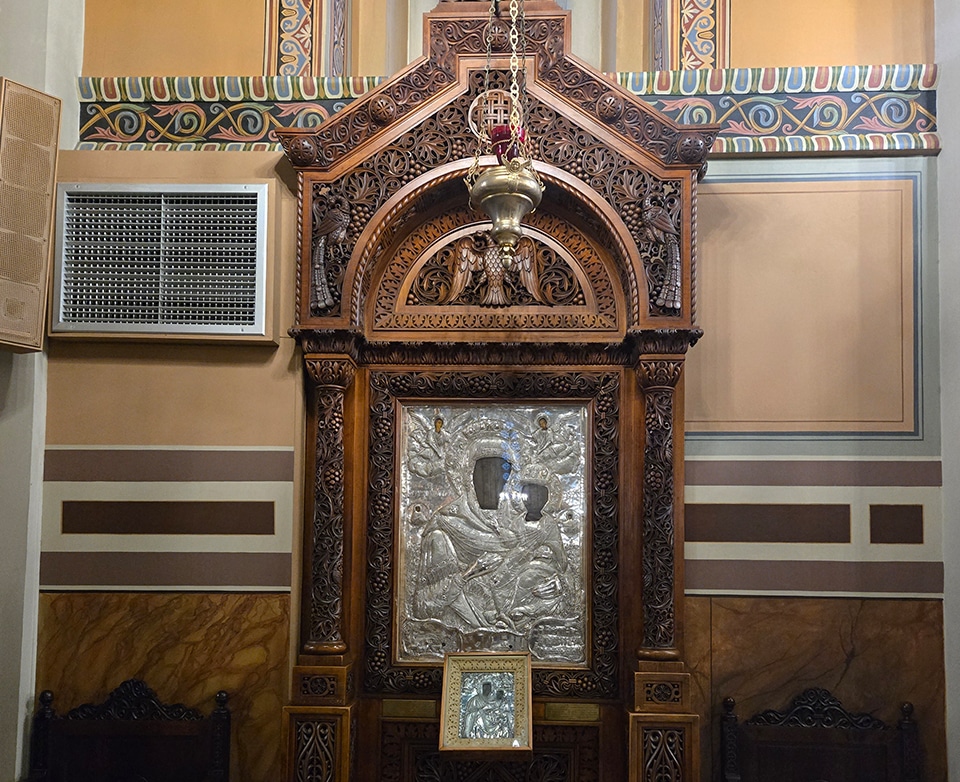 “All-Holy Mother of God Myrtidiotissa”, a copy of the icon of BVM Myrtidiotissa of Kythera, is a votive offering deposited by the Kytherians in Athens in 1860.
Icons of Christ and the All-Holy Virgin Mary
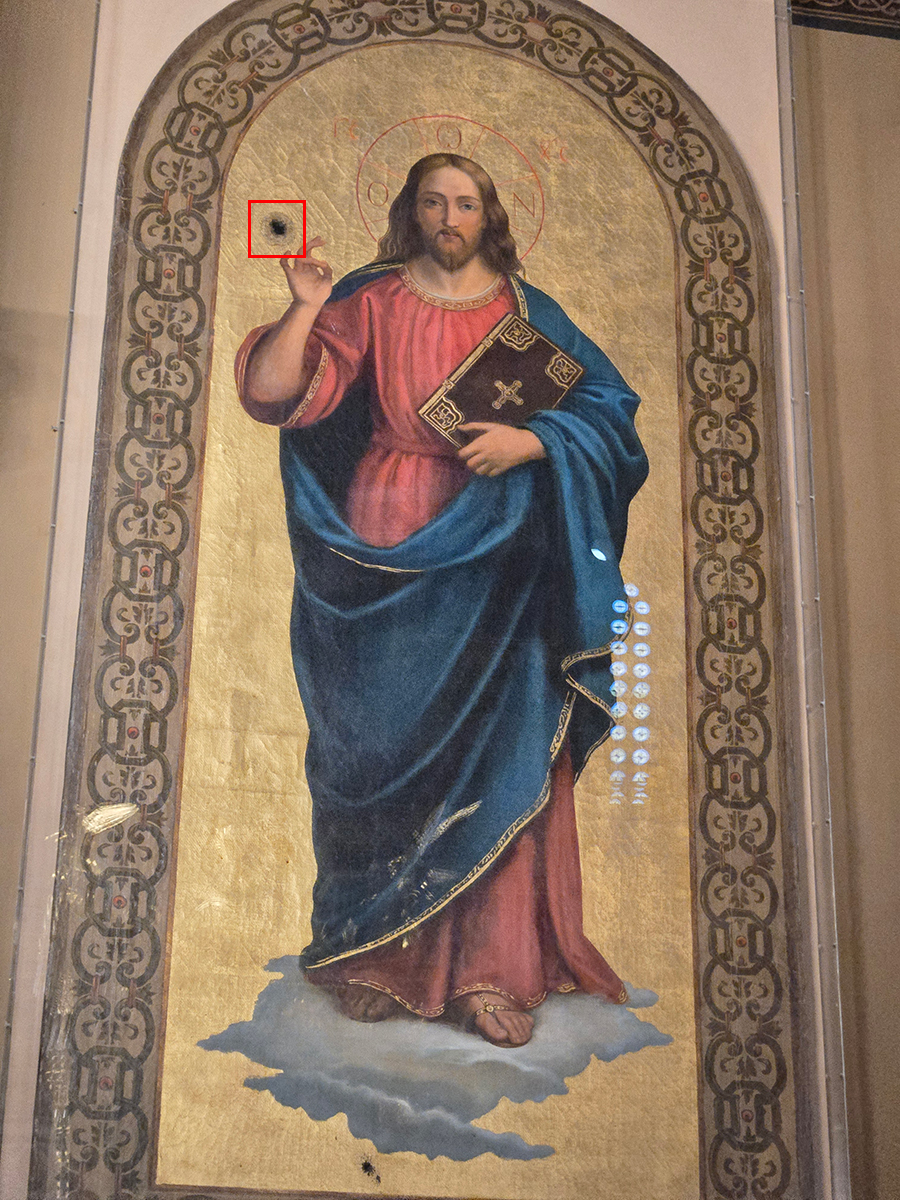 Two icons connected with historical events are placed to the right and to the left after the middle of the church and bear the traces of the shooting during the “Gospel riots” inside the church. One of them depicts Christ and the other one the All-Holy Virgin Mary.
“Gospel riots” were the bloody clashes which broke out on November 8, 1901, following in the newspaper Akropolis of a translation into modern spoken Greek of the Gospel of Matthew by the demoticist Alexandros Pallis.
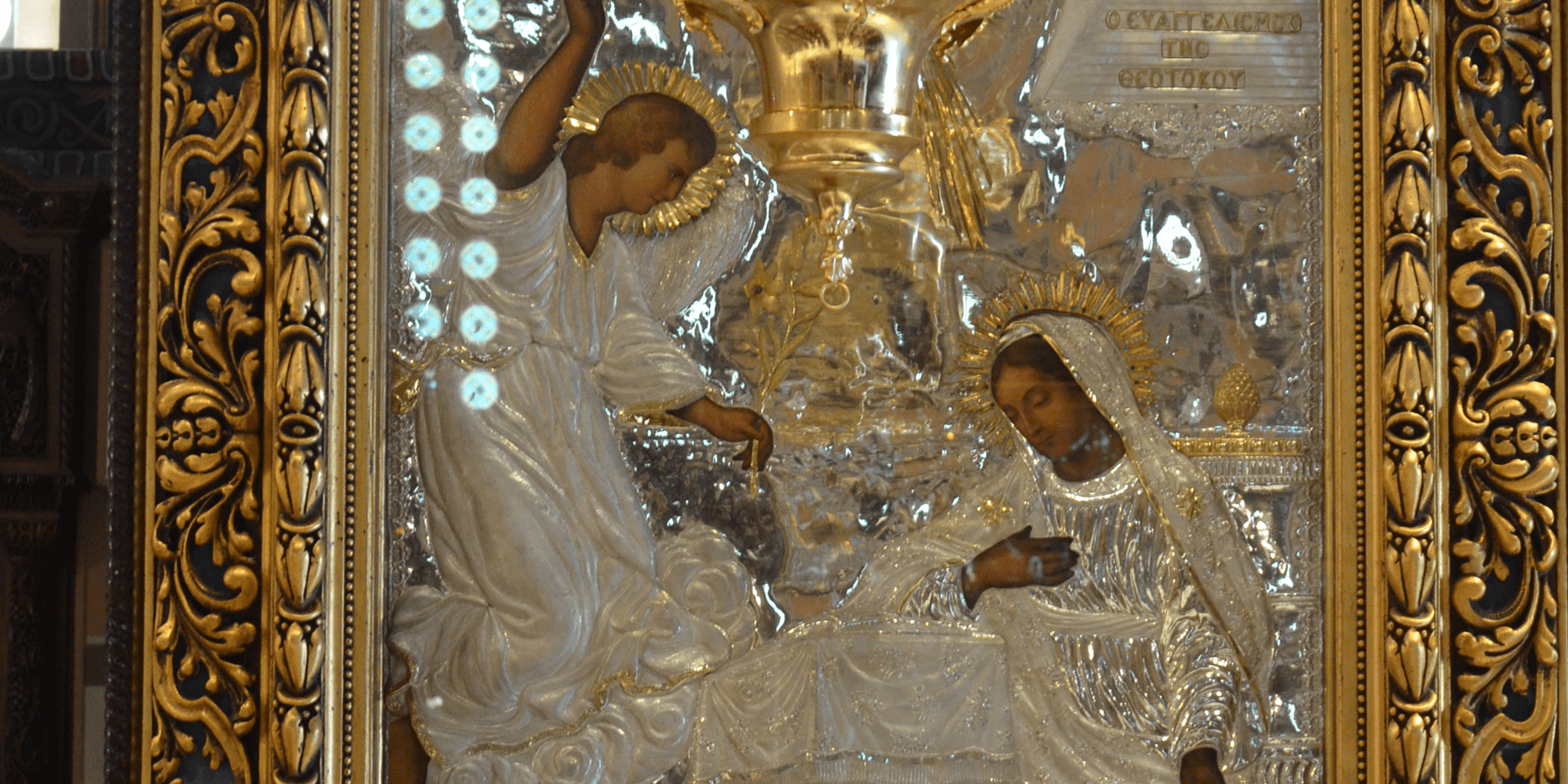
Silver icon of the
Annunciation of the Mother of God
The icon of the Annunciation of the Mother of God is painted on tarpaulin and has a silver plating. There is an inscription which gives us the historical facts of its plating. “Created in the year of our Lord 1899, under Metropolitan Prokopios II of Athens, Mayor Lambros Kallifronas, paid for by the church and through the care of commissioners Alkiviadis Kambas and Constantinos Ghinakas”. The silver plating was elaborated by I. Niketopoulos in the year 1899”.
Silver icon of the Dormition of the Mother of God
The icon of the Dormition of the Mother is painted on tarpaulin and has a silver plating. There is an inscription which gives us the historical facts of its plating: “Created in the year of our Lord 1901, under Metropolitan Prokopios II of Athens, Mayor Spyros Merkouris, paid for by the church and through the care of commissioners Alkiviadis Kambas, Constantinos Ghinakas, Gheorghios Papaspyropoulos and Gheorghios Diamessis”. The silver plating was elaborated by I. Niketopoulos in the year 1901.
The Holy Iconostasis
The sanctuary is separated from the main body (nave) of the church by a tall, sculpted iconostasis, vested with marble, of great luxury, as the entire sculpted decoration of the church. In the centre the Beautiful Gates (Holy Doors) predominate in a protrusion. It is framed by marble small plain columns out of green marble from the island of Tinos, supporting multiple arches pulled out on the coating. Above them there is a triple superimposed pediment ending in an antefix. On each side of the Beautiful Gates there are two double arches on a tall socle, supported by small plain columns out of green marble, while four pilasters of a rectangular cross-section and out of red Capandriti marble frame the composition. Above these, an architrave is developed with inlaid round stitharia (portraits) of saints in it. The composition of the iconostasis closes with a large architrave out of a series of little arches with the Twelve Great Feasts (Dodekaorton), supported by small plain columns out of green marble.
At the centre, above the Beautiful Gates an elevated composition predominates with an arch supported by twin small plain columns out of red marble and an ending in an antefix framing a depiction of the Last Supper. The iconostases of the parabemata (the prothesis or diakonikon and the sacristy) are of a similar form, though of a more limited composition and less tall. The arches of the doors are supported by small plain columns out of green marble, while the architrave is decorated with portraits of saints. Behind the iconostasis, which is one metre thick, there are storing spaces. The icons of the iconostasis are by the German painter Alexander Maximilian Seitz and Spyridon Ghiallinas.
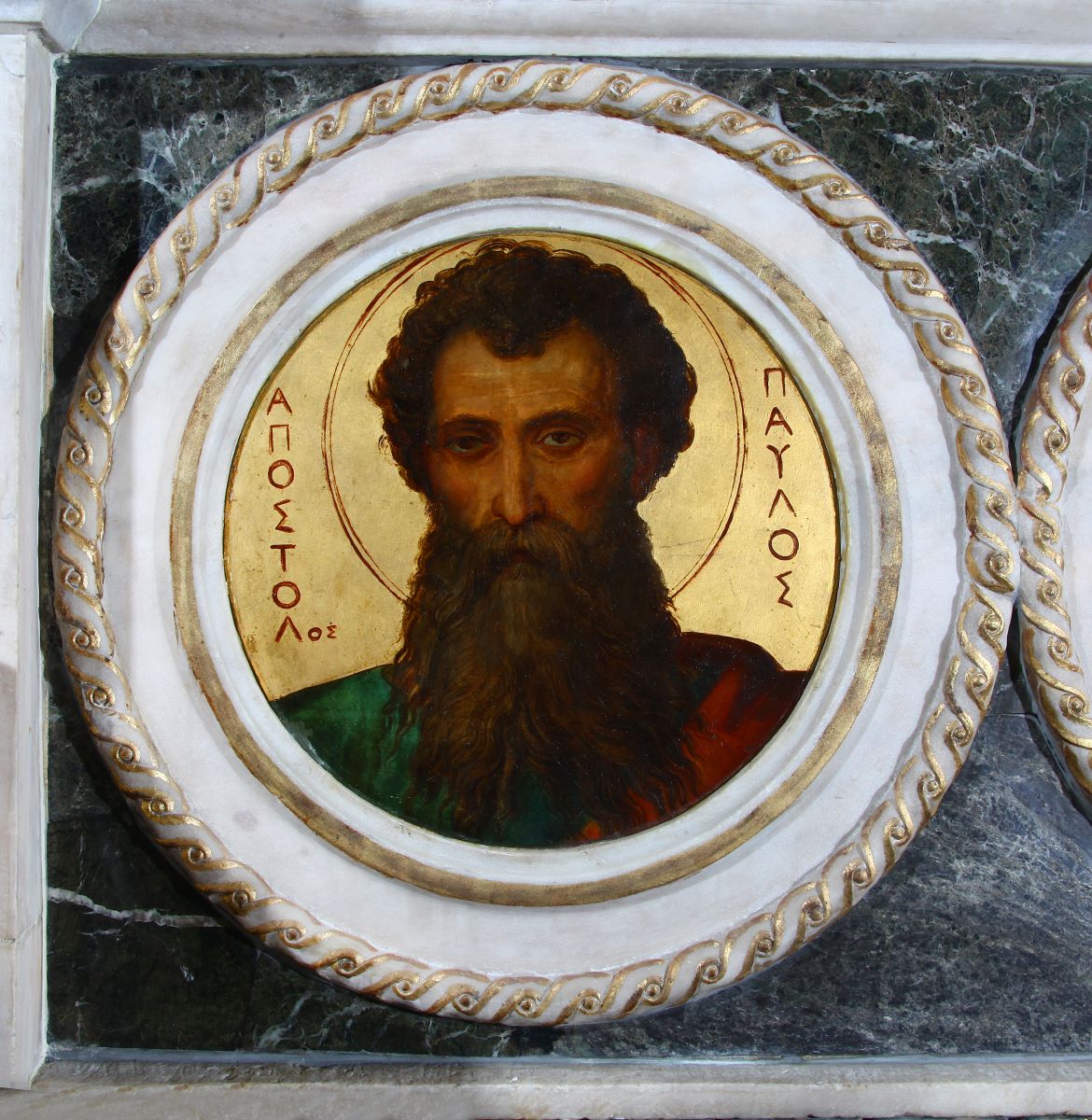
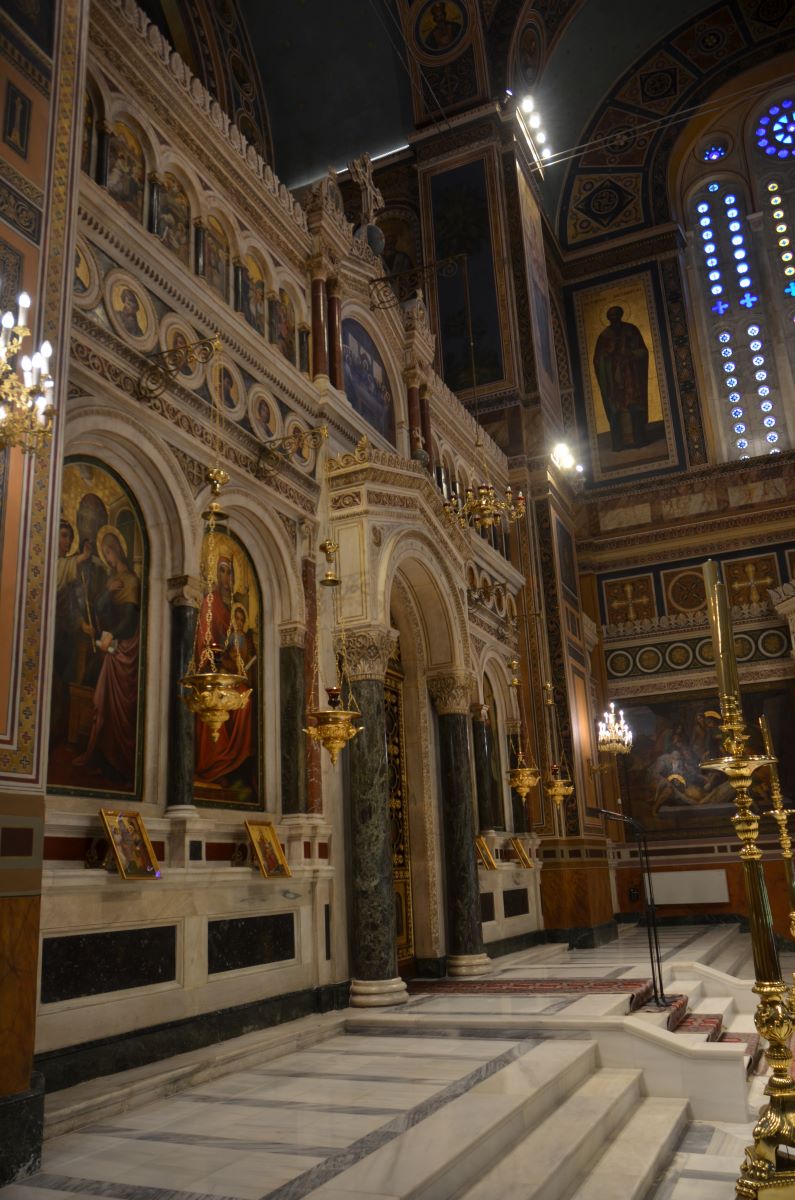
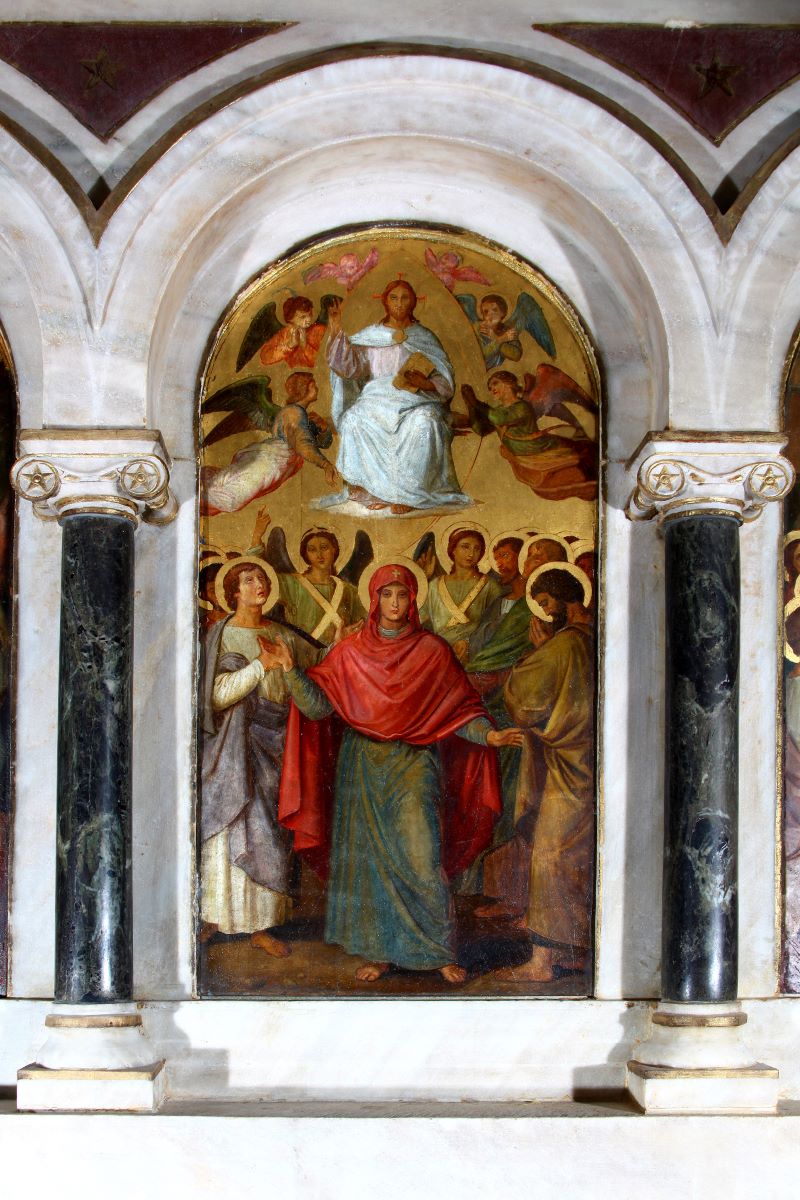
Part of the Chain of Apostole Paul
The holy heirloom consisting in a part of the venerable chain of the Holy Apostle Paul was donated by the Roman Catholic Church to the late Archbishop Christodoulos of Athens and all Greece in December 2006 and since then was kept in the heirloom vault of the Cathedral. Following the completion of the restoration works (2016) it was unanimously decided by the Ecclesiastical Council of the church to construct a stand, made of marble of exquisite quality from Dionyssos (measuring 0.90m X 0.66m X 0.53m), on which the holy heirloom inside a special container made of alabaster was placed. The stand was designed by the architect Klimis Aslanidis to fit in with the space of the church and the related sculptures. Its construction was assigned to the sculptor Michail Vidalis under the supervision of Professor Praxitelis Tzanoulinos.
Holy Standards
Colourful silk, golden and silver threads on silk velvet, measuring 0.73 X 1.80 m. Embroidery workshops of Moscow, mid-19th century.
Three-tongued embroidered icon banner depicting Saint Nicholas on its recto and a representation of the Resurrection of the Lord on its verso, inside medallions, richly embroidered with finest gold-and-silver-woven threads on blue silk velvet, surrounded by dense and precious decoration. There are two such standards constituting a pair and exhibited close to one another as excellent samples of the Russian ecclesiastical art of embroidery, specifically created for the Greek market, as is attested by the use of blue velvet (of the national Greek colour) instead of the purple colour normally used. The addition of processed paper pulp in relief as a basis for the embroidery gives a unique three-dimensional effect and volume to the figures depicted. It belongs to the founders’ heirlooms of the Holy Cathedral of Athens.
Cross and Hexapteryga [i.e. liturgical fans] of Procession
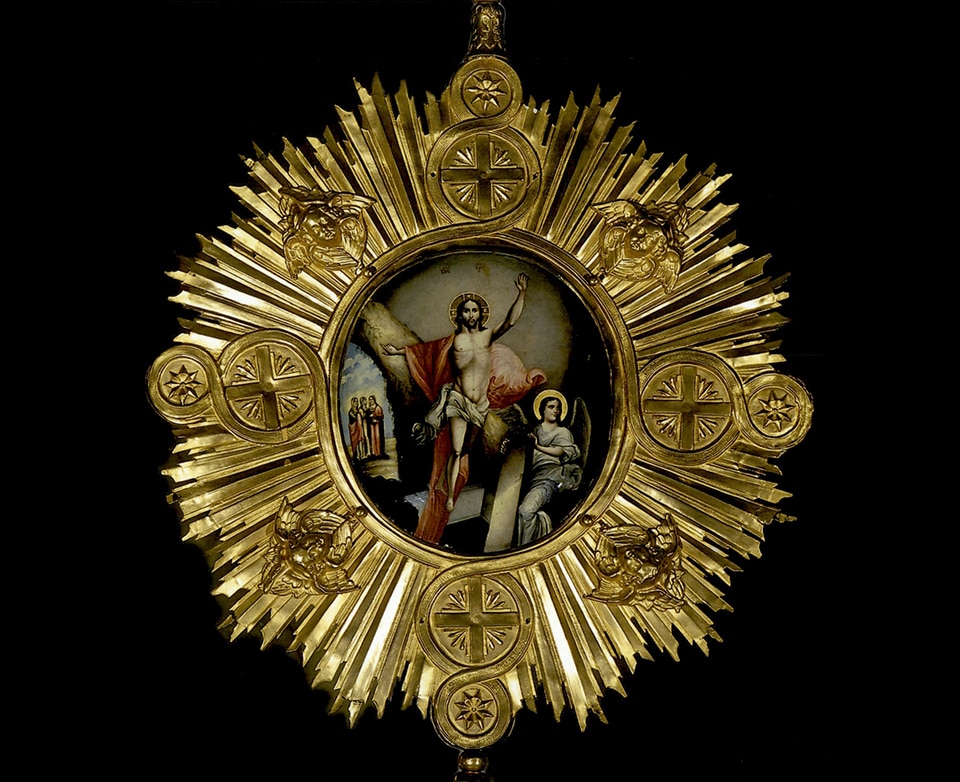 An excellent token of Russian silversmithing. The Holy Cross, measuring 0.80 X 0.49m is wooden, painted on both sides, with a representation of the Crucifixion, of Lord God of Sabaoth on its recto and of the symbols of the Passion on its verso. It bears a gilded brass coating. The hexapteryga consist of large circular icons made of enamel with elaborate radial metal decoration.
Icon of Saint Philothei
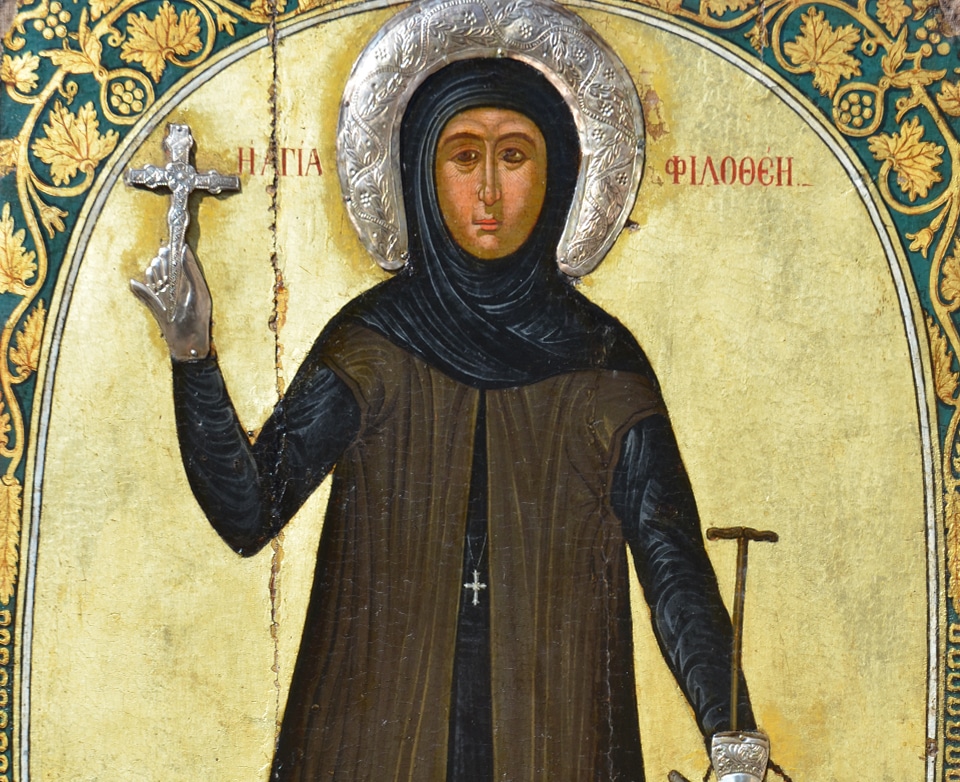 Icon painting on wood, measuring 0.85m X 0.56m.
It depicts Saint Philothei standing, vested in the monastic habit (schema), holding the Holy Cross upright with her right hand and an unfolded scroll (eiletarion), the hegumen’s crozier and a prayer rope with her left hand. The entire representation of the Saint is painted within an ellipsoid frame decorated with vegetal patterns along its circumference. From an inscription stating “In the year of Christ αψγ΄ – (1703)” we draw the conclusion that this is the oldest portable icon of the church.
Cathedra
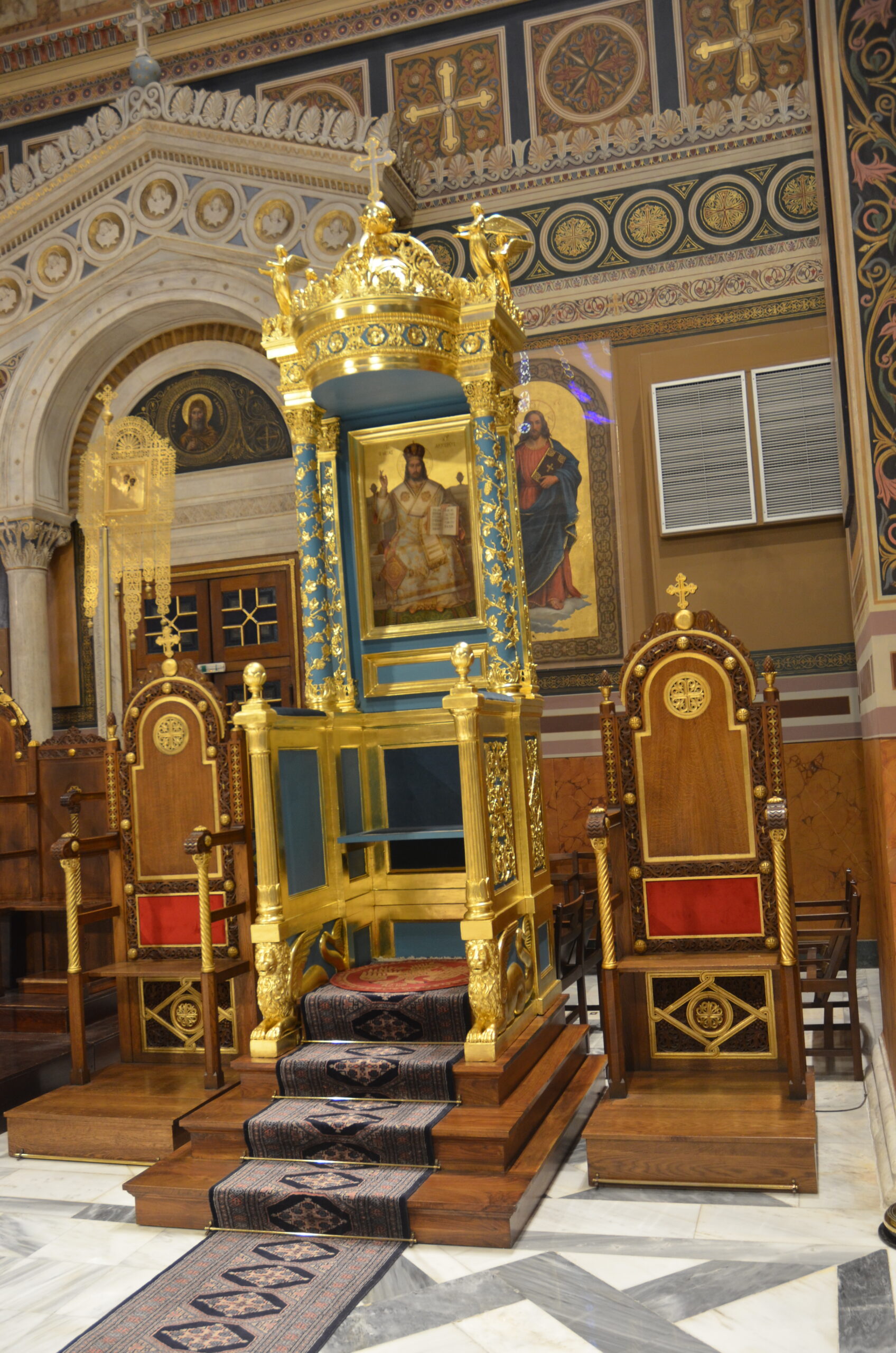 The Cathedra is wood-carved, gilded, polished, colour-painted. Height: 3.60m. Width: 1.03m. Depth: 1.20m. Columns: height 1.06m; diameter 0.18m; height of the seat 1.13m; width 0.70m; depth 1.10m. Icon: height 1.05m; width 0.65m, uninscribed.
At its base it bears two sculpted lions and on the baldachin four fully sculpted angels, floral decoration, and a cross relying upon globes. On the sides it bears panels with crosses. Its canopy is supported on two columns with a gilded vine branch in relief and bearing Corinthian capitals. The icon of the Great Archpriest is an oil painting of classical art.
Holy Pulpit (ambon, in Greek)
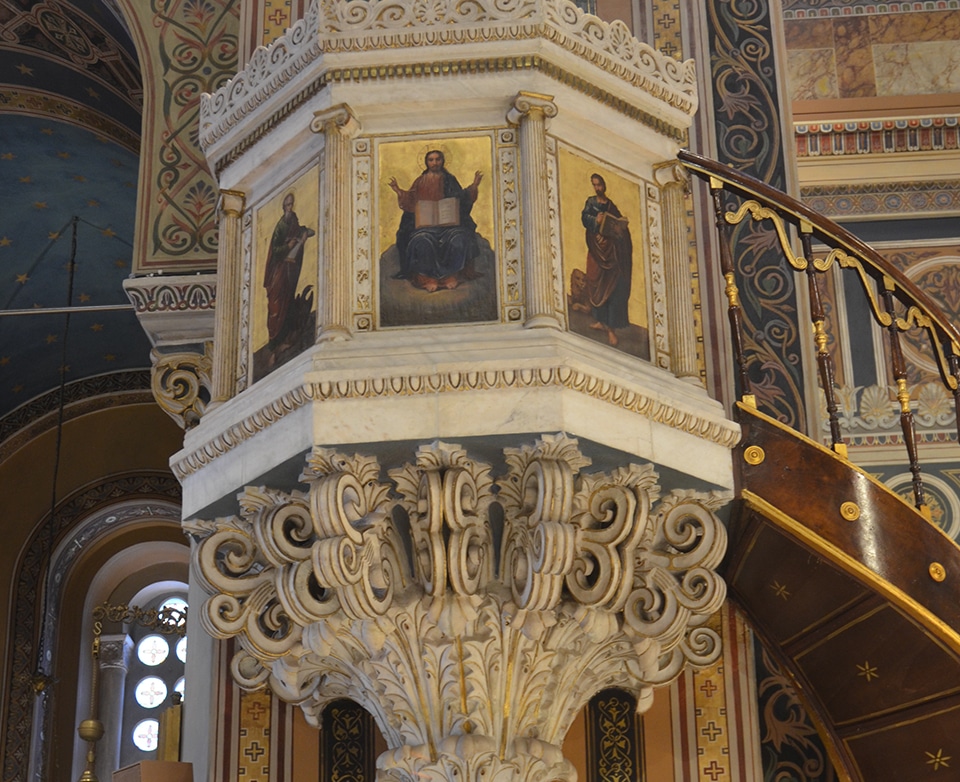 This sculpted work is due to the artist Gheorghios Phytalis from the island of Tinos (1830-1901). Originally it was placed 1m higher. In the 1960s during the prelacy of Archbishop Chryssostomos (Hadzistavrou) (1880-1968) the ambon was placed where it is today for practical reasons.
Saint Eleutherios (All-Holy Blessed Virgin Mary Gorgoepikoos “She who is Quick to Hear”)
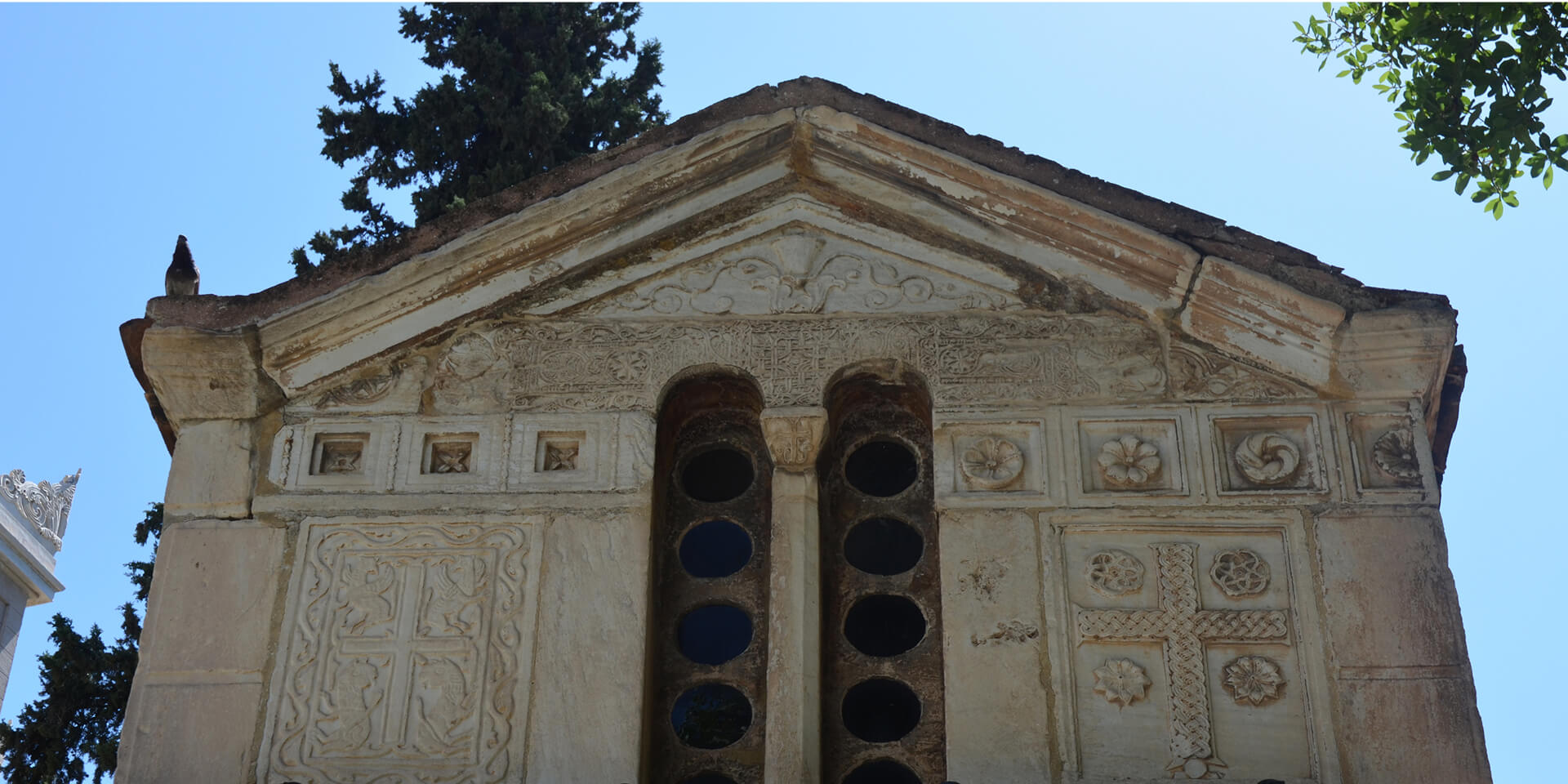
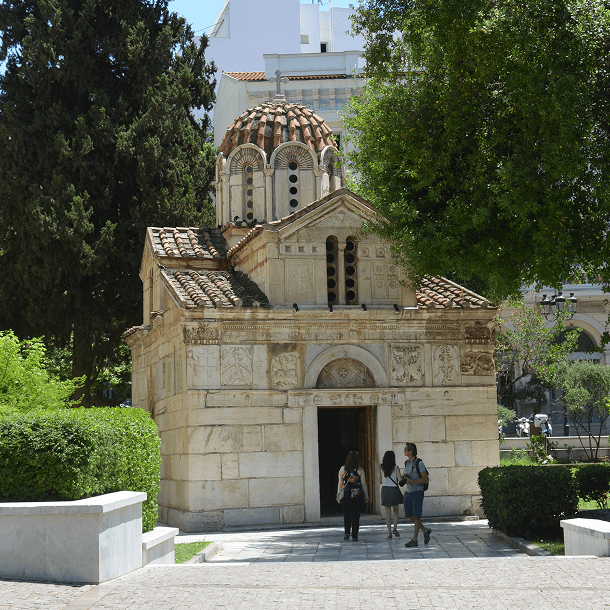
It is a small but very significant and historic holy church dedicated to the All-Holy Blessed Virgin Mary Gorgoepikoos (or Gorgoypikoos, also in Greek), in Metropoleos Square, exactly next to the Metropolitan Cathedral. It is also known to Athenians as Saint Eleutherios —an appellation given to it following the liberation of the city of Athens from the Turks— or “the Small Metropolitan Church”.
Erected on the site of a temple of Eileithyia, the ancient Greek goddess of childbirth and midwifery, the church of Saint Eleutherios was originally dedicated to the veneration of the miraculous icon of BVM Gorgoypikoos. Following the Liberation, it accommodated the Library of the city for a short period of time and, upon the termination of the Bavarian Rule, it was restituted to its initial use and the original appellation was given to it.
It is a church of the 11th or 12th century, cross-in-square inscribed with a dome. Its dome is preserved in a very good state and constitutes the best extant example of the Athenian type. The construction of the church follows the cloisonné system and in the higher part of its masonry, particularly above the windows there are dozens of incorporated reliefs from all the historical phases of the city (ancient Greek, Palæochristian, Byzantine).
It constitutes a creation which makes up a historical recapitulation of the history of the sculpture of the land. The wall paintings preserved in the interior of the church were mainly elaborated in the 20th century, while there also was an older layer (probably of the 16th-17th centuries), which has not been preserved.
It was in this chapel that the consecration of Saint Dionysios of Zante as bishop of Aeghina was held in 1577.
